How long have you been working in sPHENIX and at what institution?
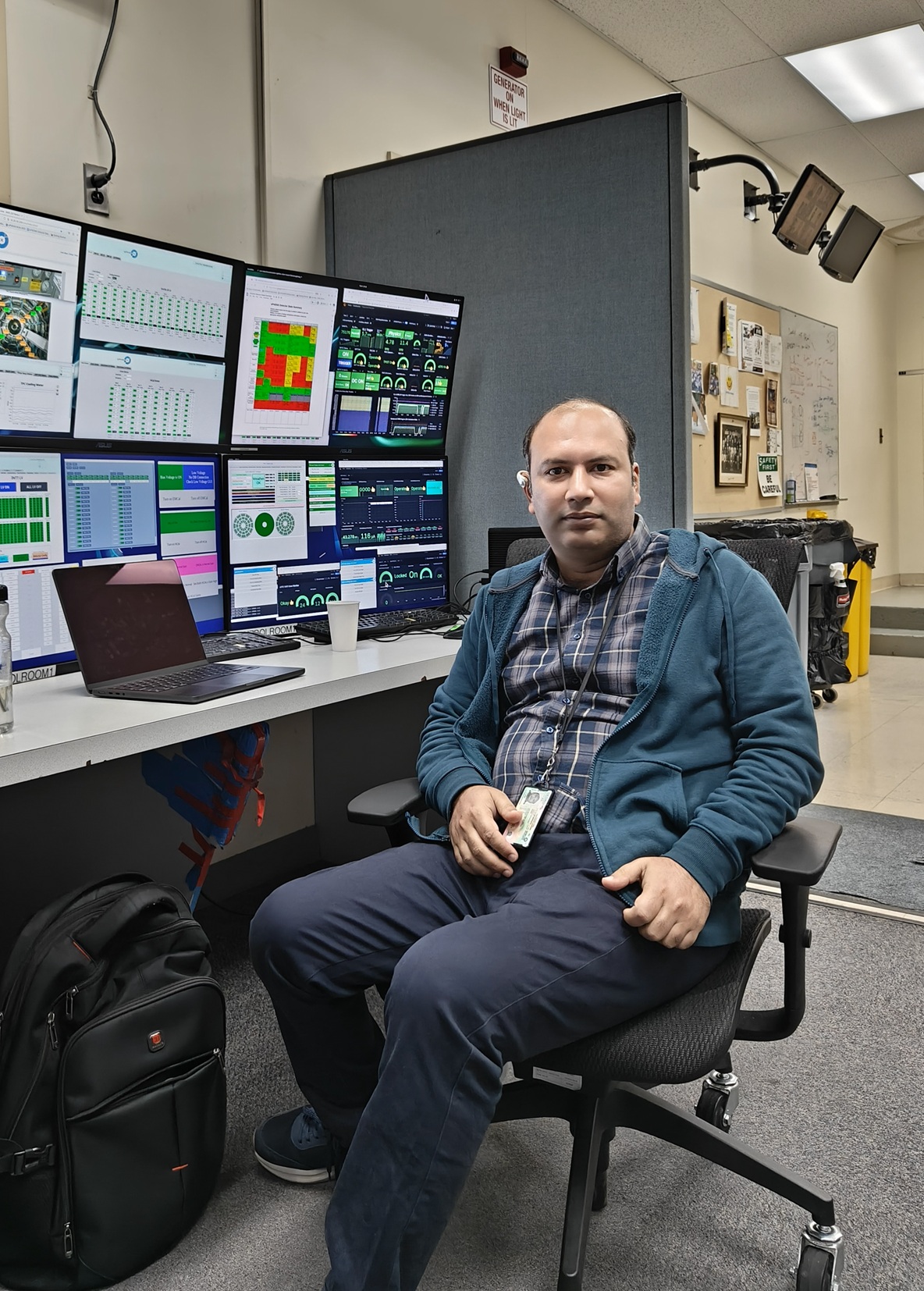
I joined Georgia State University (GSU) in August 2025 as a Postdoctoral Research Assistant, and I have been working with the sPHENIX collaboration for almost six months.
What is the focus of your work on the sPHENIX experiment? What is the title of your Ph.D. or tentative title?
My work on the sPHENIX experiment focuses on detector operations and HCAL performance, where I serve as an HCAL detector expert supporting data taking and calibration. I am actively involved in HCal calibration studies using LED and cosmic-ray data to ensure stable and accurate energy measurements. In parallel, I am developing a Particle Flow Algorithm to improve event and jet reconstruction by combining tracking and calorimeter information.
My PhD research focused on Underlying Event (UE) properties in pp and p–Pb collisions at √s = 5.02 TeV with the ALICE experiment, where I presented the first measurement of UE in p–Pb collisions at this energy. I analyzed charged-particle number and Σpₜ densities and found similar UE behavior in both systems, in agreement with EPOS LHC and PYTHIA 8 simulations. Furthermore, I contributed to quarkonium studies, including J/ψ and upsilon production measurements, using them as sensitive probes of QCD dynamics and medium effects.
Where did you grow up and what is your educational background before your current position?
I was born and raised in Pakistan, where I completed my undergraduate and master’s studies in physics at the University of the Punjab. I then moved to China to pursue my PhD at Central China Normal University, where my research was conducted within the ALICE collaboration at the Large Hadron Collider (LHC).
Awards or biggest talk highlight?
My research highlights include a JHEP publication on Underlying Event measurements with the ALICE collaboration. I am the principle author of a journal paper on oxygen–oxygen collisions based on EPOS4 simulations, and a co-author of strangeness enhancement studies oxygen–oxygen collisions using AMPT and EPOS4.
How did you decide to go into heavy ion or spin research?
I decided to go into heavy-ion research because I was interested in understanding how matter behaves under extreme conditions created in high-energy collisions. During my graduate studies in physics, I became fascinated by collider experiments, which led me to pursue my PhD within the ALICE collaboration at the LHC, focusing on Underlying Event and particle production studies.
What do you like to do in your spare time?
In my spare time, I enjoy playing sports, reading, and spending time with friends, as well as traveling and exploring new places and cultures.
Fun fact?
I’ve lived and studied in three different countries, so I’ve experienced very different academic and cultural environments.