How long have you been working in sPHENIX and at what institution?
I have been working on sPHENIX since June 2025. At that time, I was finishing my second year at the University of Tennessee, Knoxville, and I have now started my third year.
What is the focus of your work on the sPHENIX experiment? What is the title of your Ph.D. or tentative title?
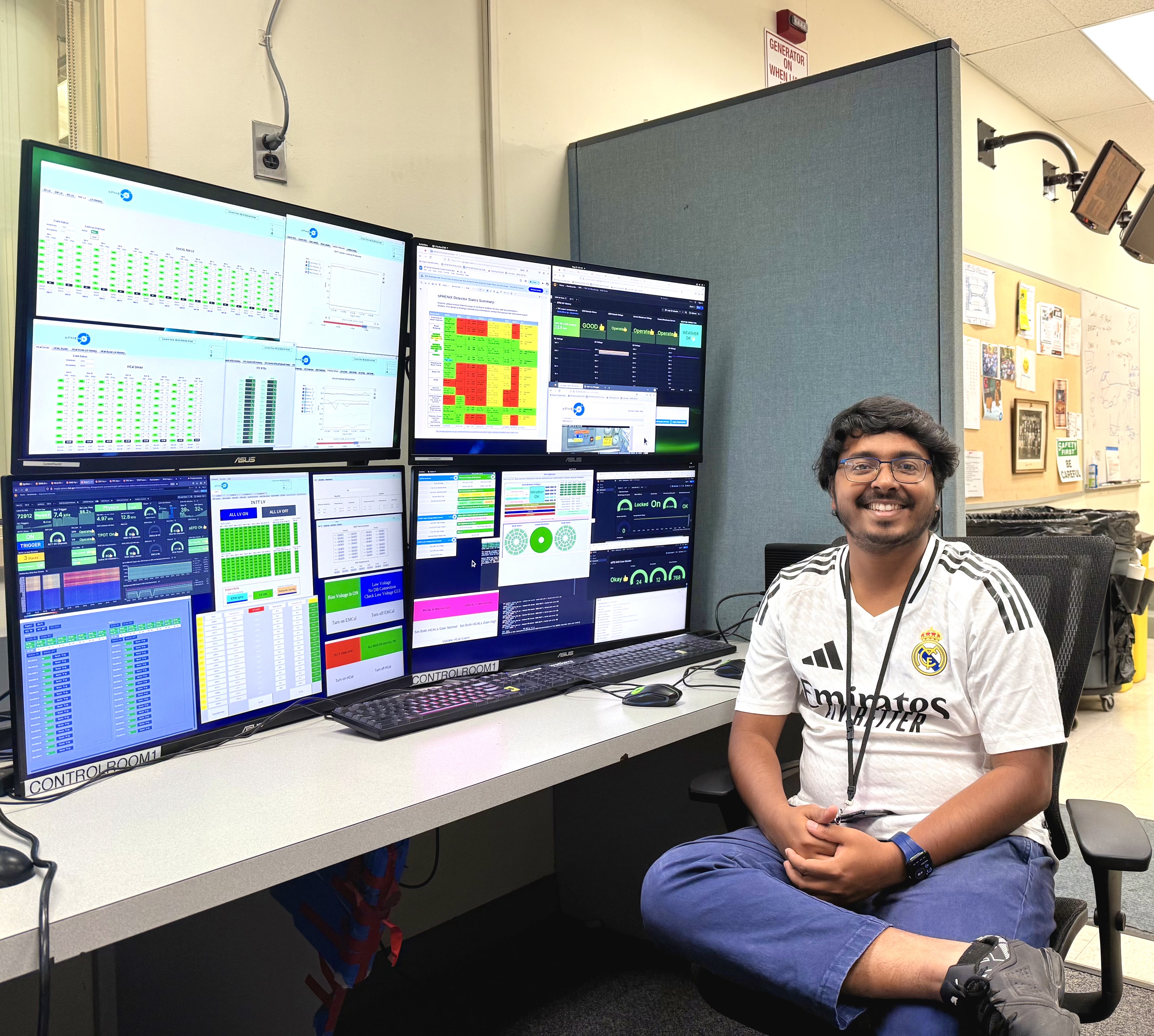
I am an on-call MVTX expert, responsible for resolving issues that arise during data taking and providing on-site support during detector operations. My analysis work currently focuses on topological clusters, with the goal of developing and applying the particle flow algorithm within the sPHENIX framework. Although I have not yet finalized a thesis title, my planned dissertation will focus on measuring jet azimuthal anisotropy coefficients (vn) in Au+Au collisions under the supervision of Prof. Christine Nattrass. I plan to develop machine learning techniques to optimize the particle flow algorithm, enabling more accurate and reliable jet vn measurements.
Where did you grow up and what is your educational background before your current position?
I was born and raised in Chittagong, Bangladesh. Although I initially wanted to become an engineer, I later completed both my bachelor’s and master’s degrees in physics at the University of Chittagong. I then decided to pursue a Ph.D. in physics and joined UTK.
Awards or biggest talk highlight?
When I was a master’s student in my home country, I presented my thesis work as a poster at an international conference. It was my first ever presentation, and I received the Best Poster Award for it.
How did you decide to go into heavy ion or spin research?
I carried out my master’s research in medium-energy nuclear physics in collaboration with the University of Fukui, Japan. My work focused on measuring the total charge-changing cross section of 12C using CR-39 nuclear track detectors, with experiments performed at the Wakasa Wan Energy Research Center (WERC) and the Heavy Ion Medical Accelerator in Chiba (HIMAC), Japan. This work provided me with a strong foundation in nuclear reactions, sparking a deep interest in exploring nuclear matter under more extreme conditions. So I wanted to pursue my Ph.D. in heavy-ion research. Later, I was encouraged and motivated by my master’s supervisor, Prof. Dr. Quazi Muhammad Rashed Nizam (Department of Physics, University of Chittagong, Bangladesh), to enter the field of heavy-ion physics.
What do you like to do in your spare time?
I love traveling and enjoy going camping and hiking. I also like spending my time listening to classic rock bands such as Scorpions, Guns N’ Roses, Pink Floyd, and some Bangladeshi bands. Whether I’m driving or cooking, listening to music is a must for me.
Fun fact?
When I started taking owl shifts, RHIC and sPHENIX failures mysteriously began to occur. It seemed like every possible issue happened whenever I was on shift. So everyone stays extra alert when I’m scheduled for the next owl shift! Hahaha…