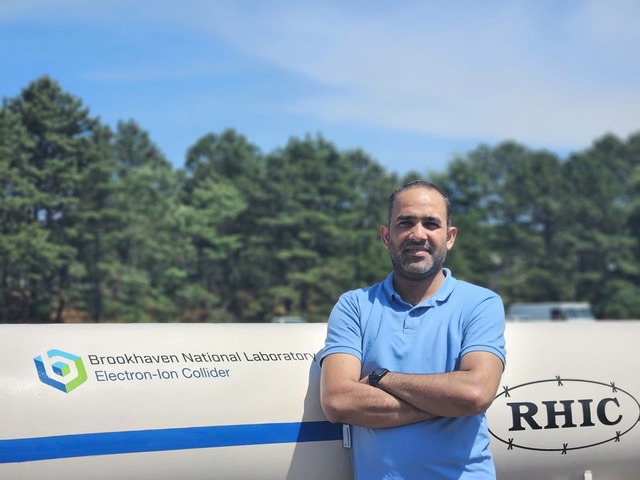
How long have you been working in sPHENIX and at what institution?
I have been working with the sPHENIX collaboration since September 2024, when I joined the Department of Physics and Astronomy at Wayne State University as a postdoctoral researcher.
What is the focus of your work on the sPHENIX experiment? What is the title of your Ph.D. thesis?
My work in sPHENIX has two main directions. My long-term physics goal is to use sPHENIX data to study V0-V0 correlations and explore how strange particles are produced and correlated in high-energy collisions. To my knowledge, this measurement has not been explored at RHIC energies before. In parallel, I contribute to detector tracking calibration, working to improve tracking performance and support the precise measurements the experiment depends on.
I completed my Ph.D. in 2019 at Tsinghua University in Beijing, China. My thesis was titled “Experimental Studies of Strange Hadron Production in Heavy-Ion Collisions at STAR/RHIC.” After my doctorate, I gained research experience with the CMS, ALICE, and NA61 experiments at CERN before joining sPHENIX at Wayne State University. Working across several major experiments shaped how I approach problems today.
Where did you grow up and what is your educational background before your current position?
I grew up in Noor Shah, a small village near Sahiwal in Punjab, Pakistan. I completed my M.Sc. in Physics at the University of the Punjab. I then moved to Beijing to pursue my Ph.D. at Tsinghua University, where my research focused on experimental data from the STAR experiment at RHIC.
Awards or biggest talk highlight?
My biggest highlight was presenting “Recent Results on Strangeness Production from STAR” at Quark Matter 2019. In that talk, I presented the first measurements of strangeness production in Au+Au collisions at 54.4 GeV.
How did you decide to go into heavy ion research?
The big questions about the early universe drew me in. Heavy ion collisions let us recreate conditions that existed microseconds after the Big Bang and study matter in one of its most extreme states. Once I understood what this field was trying to answer, the direction became clear.
What do you like to do in your spare time?
I enjoy traveling and visiting new places. I also spend time with family, cook, and get outside when I can. That balance keeps me grounded during intense periods of research.
Fun fact?
I am the first person from my village and family to pursue a Ph.D. and a career in physics research. Physics took me to places I never imagined as a child.